
Ice, snow and sleet crushed barns and arenas across the South. Learn how to handle structural failures and ways to protect your equine property before the next storm.
Last week, Winter Storm Fern tore through the Southeast, leaving a trail of destruction from Texas and Oklahoma to North Carolina. The storm brought some of the heaviest ice accumulation to Tennessee and North Mississippi. While the freezing temperatures were challenging, the sheer weight of ice and snow proved catastrophic for agricultural and horse farm infrastructures.
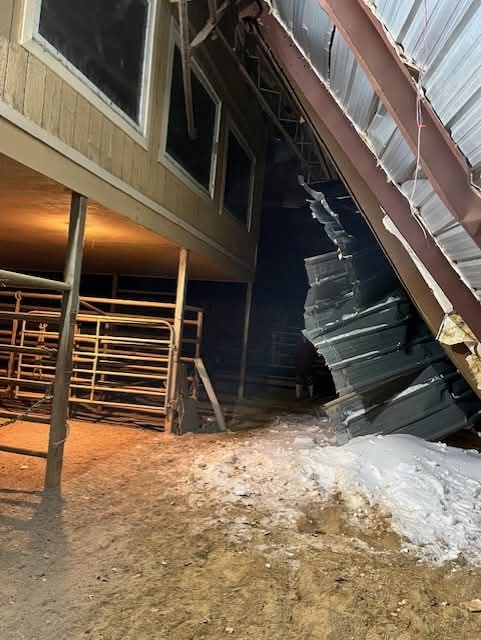
Reports confirm that the heavy accumulation caused dozens of barns and indoor arenas to buckle and collapse. In the Texoma region alone (spanning Southern Oklahoma and North Texas) reports of at least 39 barns and covered arenas failed under the strain. In Grayson County, Texas, steel beams twisted at Loy Lake Park, bringing down livestock barns just weeks before scheduled livestock shows. In Tennessee and North Mississippi, reports emerged of over two to three dozen arenas and barns crashing down in the Mid-south region. The damage left facility and horse owners devastated, sparking urgent warnings to evacuate horses from similar structures immediately.
For farm and horse owners, a structural collapse is a nightmare scenario. Beyond the immediate physical danger, the aftermath involves navigating complex insurance claims and rebuilding efforts. To help owners manage the crisis, Marcella Dhority, an insurance agent with Equine Insurance Professionals LLC, a division of Central Virginia Insurance Agency, provided critical advice on navigating structural failures and securing proper coverage.
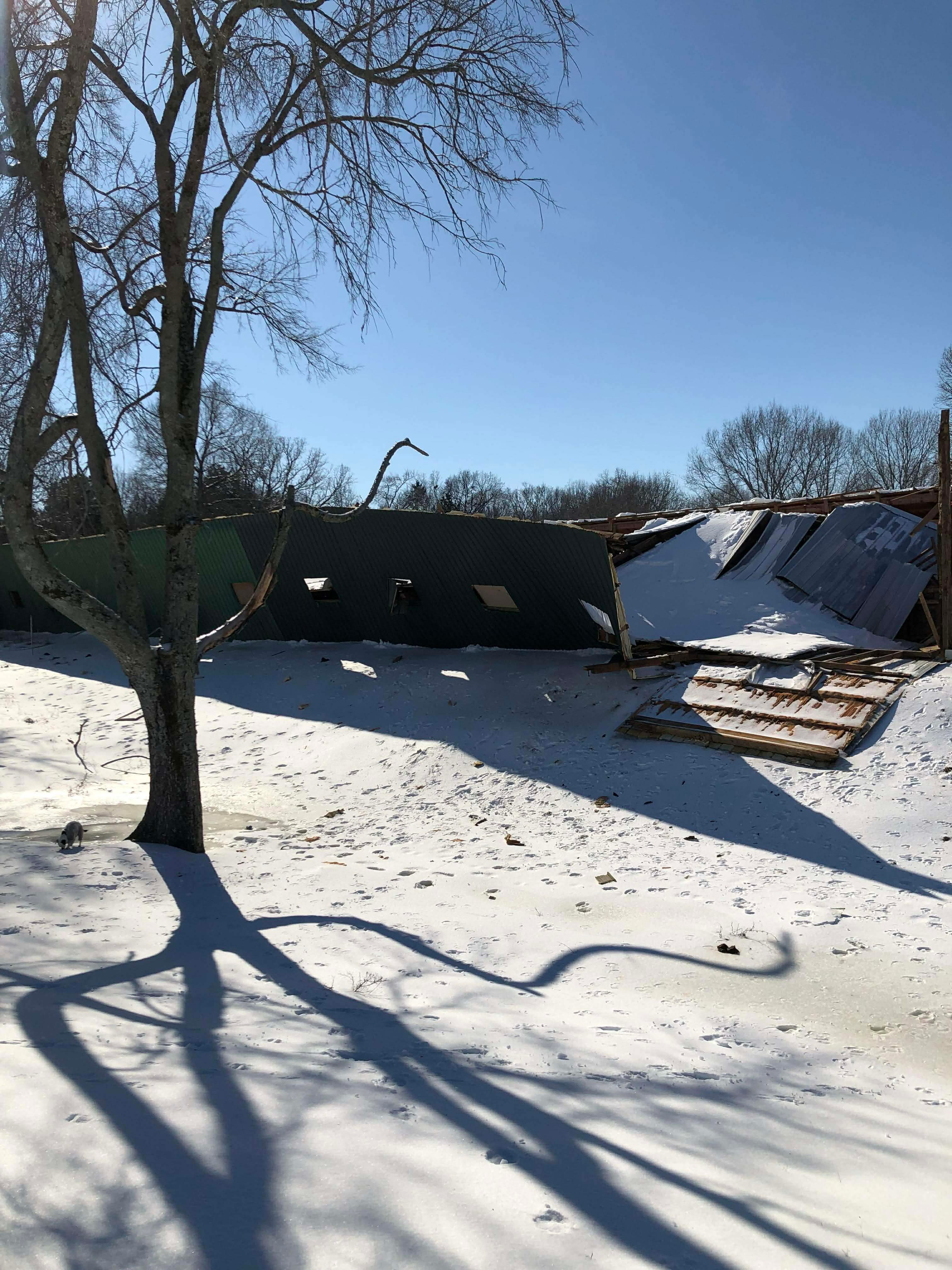
Table of contents [Show]
Immediate Steps After a Collapse
When a barn or arena falls, the instinct to immediately clean up can be strong, but safety must come first.
"Safety is the top priority," Dhority says. She advises owners to immediately secure the area and keep people away from unstable structures. If animals are involved, move horses or livestock to a safe location immediately and contact emergency services or a veterinarian if needed.
Once safety is established, documentation is the next critical step. Dhority urges owners to take photos and video of all damage before moving any debris. "Report the loss to your insurance provider as soon as possible," she says. "Prompt documentation and reporting can significantly impact how smoothly a claim proceeds."
Ideally, storm losses should be reported within 24 to 72 hours. Even if the full extent of the damage isn't yet clear, opening the claim early helps preserve coverage.
The Gap Between Home and Farm Insurance
A major issue surfacing in the wake of Winter Storm Fern is the confusion regarding what policies cover these specific disasters. Many horse owners assume a standard homeowner's policy protects their barns.
"A farm, ranch, or equine property policy is generally designed to properly insure barns, arenas, fencing, equipment, and other farm-related structures," Dhority explains. "By contrast, a traditional homeowners policy does not cover farm structures of any kind nor protect horse owners from those losses. This is one of the most common—and costly—coverage gaps I see."
Dhority notes that contents inside the barn, such as tack and tools, may be covered if they are listed on the policy. However, items like hay and feed often require specific endorsements or have limited coverage.
Understanding Livestock Coverage
Another heartbreaking aspect of these collapses is the potential injury to animals inside. Owners often misunderstand how their property policy relates to their animals.
"I don't know of a single farm policy that automatically covers livestock inside a building that collapses unless there was a livestock coverage endorsement added to the policy," Dhority clarifies.
She emphasizes that equine mortality, major medical, and surgical coverage are separate policies entirely. These individual policies are what typically respond if a horse is injured or dies due to a covered accident. Relying on a property policy for animal welfare is a risk owners should not take.
Avoiding Common Claims Mistakes
In the chaos following a storm, mistakes can jeopardize financial recovery. The most frequent errors Dhority sees include:
- Delaying reporting: Waiting too long to contact the agent.
- Premature cleanup: disposing of damaged property before the adjuster can see it.
- Underinsurance: Discovering too late that coverage limits are lower than the replacement cost of the building.
- Assumptions: Believing hay, feed, or equipment are automatically covered without verifying the policy language.
Tree cleanup is another frequent point of confusion. Dhority notes that in many cases, tree removal is only covered if the tree falls on and damages a covered structure. Trees down in fields or on fence lines are often an out-of-pocket expense for the farm owner.
Winter Storm Fern serves as a harsh wake-up call regarding structural integrity for farm and facility owners. The weight of ice is deceptive; just two inches of ice on a large arena roof can add hundreds of thousands of pounds of pressure.
To understand the staggering weight of ice accumulation, let’s break down the numbers for these structures.
For a 120-foot-wide by 200-foot-long arena, the total roof area is 24,000 square feet. Ice weighs approximately 5.2 pounds per square foot for every inch of thickness. With 1 inch of ice, the total weight on the arena roof would be 24,000 square feet × 5.2 pounds = 124,800 pounds. If the ice thickness increases to 2 inches, this weight doubles to 249,600 pounds.
Now, for a smaller structure like a 40-foot-long by 48-foot-wide barn, the roof area is 1,920 square feet. At 1 inch of ice, the weight would be 1,920 square feet × 5.2 pounds = 9,984 pounds. With 2 inches of ice, the weight becomes 19,968 pounds.
These calculations highlight the immense stress ice can place on roofs, emphasizing the importance of assessing structural resilience ahead of severe winter weather.
To protect farms against future extreme weather, Dhority suggests reviewing the snow-load capacity of all barns and arenas. Owners should also keep trees trimmed away from buildings and maintain a clear emergency plan for relocating horses.
"Severe snow and ice storms can place enormous stress on barns, indoor arenas, run-in sheds, and other equine structures," Dhority says. "When a collapse occurs, the financial and emotional impact can be devastating—especially when owners discover too late that their insurance coverage wasn’t designed for a horse property."
Despite the devastation, the agricultural community is rallying. In affected areas, neighbors with standing barns have opened their stalls to displaced horses. State agencies are also stepping in. The Texas Department of Agriculture, for instance, has activated relief efforts and the STAR Fund to assist producers and ranchers facing severe losses. Among the resources available to those recovering from storm-related damage is the Tennessee Walking Horse Breeders and Exhibitors Association (TWHBEA) Disaster Relief Fund. This fund provides financial aid to address emergency needs such as repairing damage to barns and fencing. While its primary focus is on assisting Tennessee Walking Horses, the fund may also extend help to other horses if resources permit. Relief efforts like this not only provide critical support to horse owners but also underscore the importance of solidarity within the equine community during times of crisis.
For now, the focus remains on safety, documentation, and rebuilding smarter for the future. Owners are encouraged to perform an annual photo inventory of their property and review their coverage limits with an equine-knowledgeable agent before the next storm rolls through.